



For kids and their parents alike, homework can be a demanding ordeal. Often, the growing number of difficult tasks, innovative teaching strategies, and time constraints can produce a difficult home situation. But, given the appropriate assistance, parents can enable their kids to do well in college and also promote autonomy. This article will cover ten useful homework aid suggestions every parent should be aware of. These suggestions are not only about helping with college work; they are also about establishing a good homework habit that fosters learning, independence, and positive attitudes about education.
1. Set a Consistent Homework Routine
Establishing structure and stability for your kid depends on a regular homework habit. Whether it’s right after college or after supper, setting a particular time every day for homework is beneficial. Children flourish on knowing what to expect and routine. Establishing a consistent timetable and designating particular time for homework helps them mentally get ready for the next task. A set homework schedule makes kids more disciplined as well, which helps them control their time and lessens procrastination. This regular practice helps kids to value time management, a useful tool they will take into maturity.
To begin, sit down with your kid and talk about the ideal time for homework. Ensure it complements their other obligations and activities. Consistency is important; thus, follow the routine as nearly as feasible. During study time, it’s also crucial to avoid let other distractions, such as watching TV or playing with friends, intrude. A well-defined, consistent schedule gives your kid responsibility and helps him or her concentrate on the present activity.
2. Help with Learning and Writing Essays
Writing essays can be a tough task for many students, as it involves critical thinking, organising ideas, and presenting them clearly. If your child struggles with these aspects, offering help can make a huge difference. You can begin by helping them brainstorm ideas and outline the structure of the essay.
However, when it comes to more complicated assignments, professional support might be needed. Online help from experts can guide your child through the writing process, ensuring they develop strong arguments and present them coherently. If your child is facing challenges with writing their academic paper, a custom essay writing service customwriting.com could be a great solution. This service employs professionals who are skilled in various subjects and can assist in crafting well-structured essays that meet deadlines.
The ability to meet deadlines is a valuable skill that students often need to develop, and seeking professional assistance can ensure that their work is submitted on time. With the right assistance, your child will not only finish their assignment but also learn essential writing skills for future projects.
Image by sofatutor on Pexels – https://www.pexels.com/@sofatutor-95841679/
3. Create a Quiet, Distraction-Free Study Space
The setting in which a kid completes their coursework is just as crucial as the time they devote on it. A child can concentrate more on their tasks in a calm, distraction-free environment. Ideally, this location should be away from loud places like the living room or sites with continuous foot activity. A child may fully interact with their studies in a workstation in a quiet area away from the distractions of television, siblings, and other disturbances.
When designing this area, among other things, think about comfort and light. Especially if your youngster has to read or write, a well-lit room is rather crucial. Good lighting keeps children awake and lessens eye strain. Furthermore, ensure the area is tidy and has all required tools such calculators, sheets, pencils, pens, and other materials. A clean workplace will not only help your kid to be less side-tracked but also show them the need of maintaining a tidy, methodical surroundings for manufacturing.
4. Help Your Child Manage Their Time Effectively
Although it is a talent that requires practice, academic success depends on good time management. Larger chores could overwhelm some kids who find it difficult to control their college work time. Breaking assignments down into smaller, more doable steps will assist you to help. For instance, rather than telling them to “Finish your homework,” direct them with particular directions such, “Let’s start with math problems, then go on to the reading assignment.” This helps to reduce the intimidation of the homework process.
Using a timer is another good time management strategy. Set a timer for 25 to 30 minutes, then take a brief break. Called the Pomodoro technique, this approach helps you keep attention and stop burnout. Encourage your kid to stretch, snack, or do something calming during the break before going back to work. Time management helps kids learn responsibility and the need of pacing themselves, which will help them in college as well as in later life.
5. Show Interest in Your Child’s Homework
It’s important to show interest in your child’s homework to keep them motivated. Showing them that you value their education will help them to treat their college work seriously. Talk to your kid about the topic they are studying and ask them questions to find out more. This not only keeps you engaged but also allows your kid to express what they know.
Be curious, but also pay attention. At times, kids could show annoyance or bewilderment with particular chores. This is a wonderful chance for you to either provide assistance or look for other means to support them. When children observe their parents truly concerned in their academic advancement, they often feel more driven to perform well in college.
6. Encourage Your Child’s Independence
Though it’s easy to want to finish your child’s college work for them, fostering independence is really vital. The goal is for children to develop their own problem-solving ability and critical thinking skills. Help when needed but don’t fix the issues for them. Instead of giving them the answers, try guiding them with leading questions that enable them to find answers by themselves. For example, rather than completing a math problem, tell your kid, “What should we do first?” Can you recall a comparable issue we previously addressed? This strategy not only helps your kid to gain confidence but also shows them methods of problem-solving. By promoting independence, you are helping them both academically and in other aspects of life.
7. Stay in Touch with Teachers
Consistent communication with your child’s teachers can offer knowledgeable assessment of their development and areas that might require focus. Should your child struggle with particular assignments or subjects, feel free to contact their teacher. Teachers might offer ideas, extra tools, or helpful comments. Many teachers are more than eager to cooperate with parents to make sure students succeed. Open communication guarantees you and the teacher are on the same page regarding your child’s education whether by parent-teacher conferences or email.

Image by Yan Krukau on Pexels – https://www.pexels.com/@yankrukov/
8. Recognise Effort, Not Just Results
It’s only natural to commend your kid for getting an A on an assignment; yet, just as important is seeing the effort they put into their work. Your child’s awareness of the significance of the process as much as the result will be helped by your recognition of their efforts. It shows children that, despite their acquired grade, success is dependent on willpower and dedication.
Praise may be as simple as, “I’m proud of how hard you worked on that project.” Encouragement builds your child’s confidence, which then motivates them more to perform their best going forward. Emphasising their effort helps children understand that mistakes are normal in the learning process even when the results are not perfect.
9. Use Educational Games and Apps
Learning doesn’t have to be limited to assignments and textbooks. Fast and enjoyable ways to support what your child is learning in college are educational games and apps. Many apps provide interactive courses in subjects including math, reading, and science, so fostering a desire to learn. Some educational games also encourage problem-solving abilities and critical thinking, both of which are vitally essential for academic performance. Including educational applications into your child’s daily routines can enable them to strengthen college ideas in a pleasurable and engaging manner. Just be cautious to check the apps are educational and age-appropriate and to restrict screen time.
10. Stay Positive and Patient
Especially in trying circumstances, staying upbeat and patient is absolutely vital. Some assignments may be challenging for children, and homework can be bothersome. Remain calm and offer assistance during these times. Should your kid be under stress, tell them to take a short break before continuing the task.
Your attitude to homework could have a big impact on your child. Being positive will enable your child to view homework as a sensible obligation rather than a source of worry. Helping children stay task-oriented and grow resilient calls for patience.
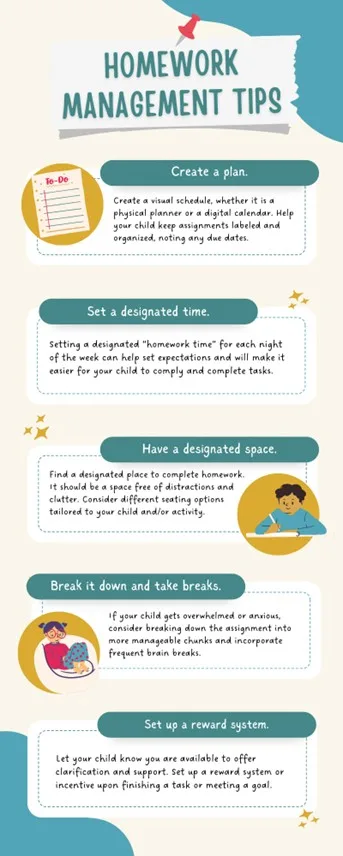
Image by https://strategiesforlearning.com/homework-management-tips/
Conclusion
Helping your kid with college work calls for patience, empathy, and a desire to participate in their educational path. Following these ten suggestions will help you to build a good atmosphere that promotes focus, independence, and academic achievement. Keep in mind that the aim is to educate vital life skills such time management, responsibility, and critical thinking in addition to merely helping kids do their tasks. Homework might be more of a chance for development than a load with the correct attitude.
Feature image by Annushka Ahuja on Pexels