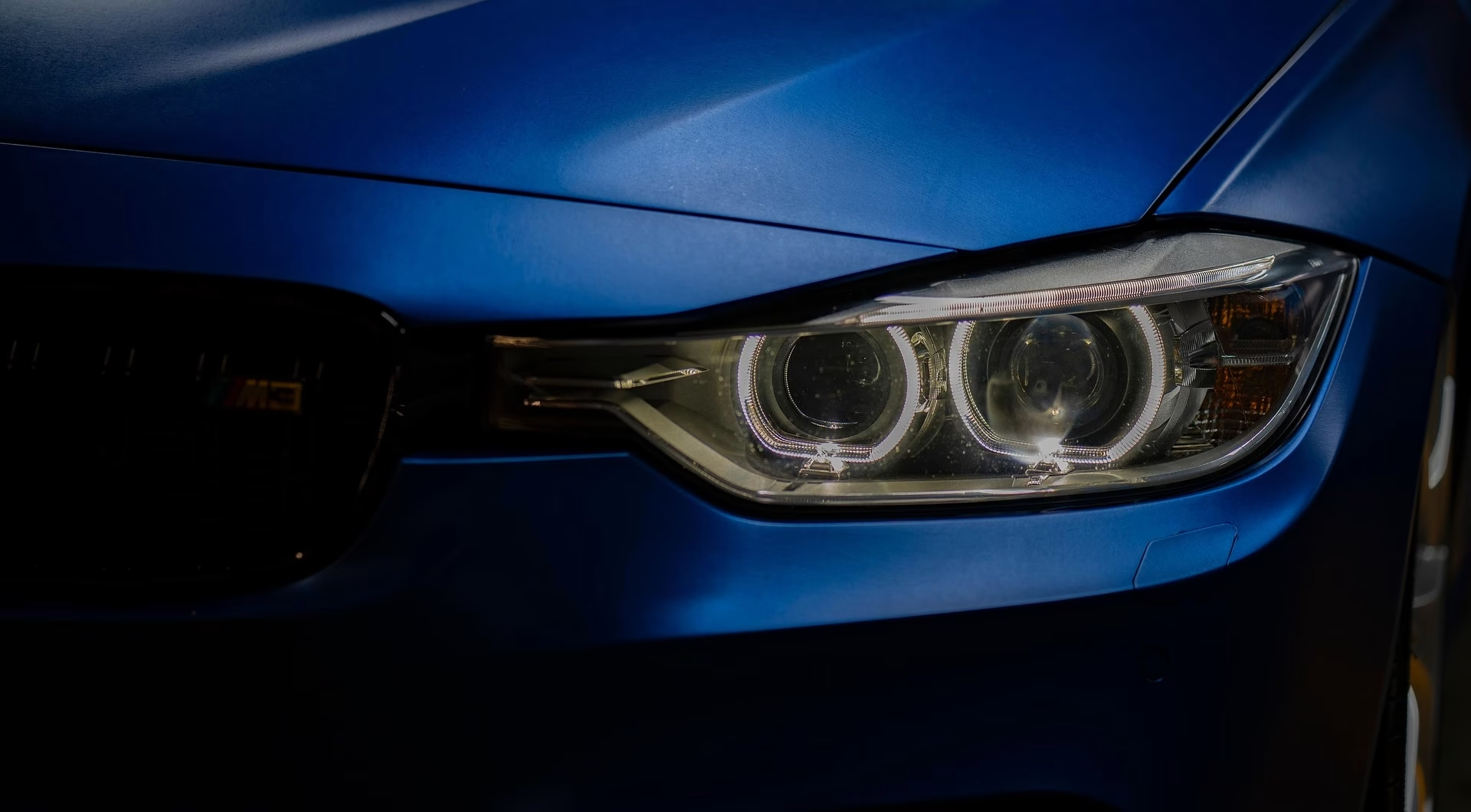

The BMW M3 is more than just a car. It’s a symbol of performance, precision engineering, and the spirit of motorsport. Since its debut in the mid-1980s, the M3 has consistently set benchmarks for what a high-performance sedan or coupe should be. It has evolved through multiple generations, each building upon the legacy of its predecessor while embracing innovation and pushing boundaries. The M3 isn’t just a sports car; it’s an institution, a name that ignites passion in enthusiasts and garners respect across the automotive world.
Origins of the M3
The origin of the 2024 bmw m3 dates back to 1986 when BMW decided to create a road-going version of a car suitable for Group A Touring Car racing. This decision led to the birth of the E30 M3, a car that changed the perception of what a compact sedan could do on the track and the street. The E30 M3 was not merely a modified 3 Series; it was a re-engineered vehicle designed from the ground up for performance. It featured flared wheel arches, a more aggressive stance, lightweight materials, and a high-revving 2.3-liter four-cylinder engine producing around 192 horsepower in its European version. The E30 M3 quickly earned a reputation on the racetrack, dominating in touring car championships across the globe and cementing its legacy as a motorsport icon.
E36 M3: A Step Toward Refinement
In 1992, BMW introduced the E36 M3, a car that marked a shift in the M3’s identity. It moved toward a more refined and luxurious design while maintaining high performance. The E36 featured a more rounded and modern look, a stark contrast to the boxy styling of the E30. Under the hood, it initially came with a 3.0-liter inline-six engine producing around 282 horsepower in European trims, and later a 3.2-liter engine increased output further. The E36 M3 was more powerful and more comfortable than its predecessor, appealing to a broader audience. While some enthusiasts missed the raw character of the E30, the E36 proved itself both on the road and the track.
E46 M3: The Legend Grows
By the time the E46 M3 arrived in 2000, the M3 had become a staple of the performance car world. The E46 generation took the M3’s performance to new heights with a 3.2-liter inline-six engine known as the S54. This engine produced 333 horsepower and featured a thrilling redline of over 8,000 rpm. The E46 also introduced new technologies such as an optional SMG (Sequential Manual Gearbox) and advanced traction control systems. While the SMG transmission received mixed reviews, the E46 M3’s combination of precision steering, responsive throttle, and balanced chassis made it one of the most beloved M3s ever built. The special edition CSL model, with its lightweight construction and increased performance, remains a highly sought-after collector’s car.
E92 M3: V8 Power and a New Era
In 2007, BMW took the M3 in a bold new direction with the E92 generation. For the first time, the M3 featured a V8 engine—a 4.0-liter naturally aspirated unit producing 414 horsepower. The high-revving V8 was a marvel of engineering and gave the E92 M3 a unique character. While the car gained weight compared to earlier models, the additional power and modern technology made up for it. The E92 also marked the introduction of BMW’s dual-clutch transmission, which provided lightning-fast shifts and improved acceleration. Despite being larger and more complex than earlier versions, the E92 M3 delivered a visceral driving experience that kept it true to its motorsport roots.
F80 M3: Turbocharging the Legacy
The F80 generation, launched in 2014, represented another significant shift for the M3. This time, BMW downsized the engine to a 3.0-liter inline-six but added twin turbochargers. The result was a 425-horsepower powerhouse that offered more torque and better efficiency than the outgoing V8. Turbocharging changed the character of the M3, providing immediate thrust at low rpm and making it quicker in real-world driving. The F80 also saw the return of the sedan-only body style, with the coupe version becoming the M4. This generation featured advanced technologies such as adaptive suspension, active differential, and carbon fibre-reinforced plastic in the structure to reduce weight. The F80 M3 was praised for its performance and criticised by some purists for lacking the naturally aspirated soul of earlier models, but it remained a dominant force on the road and track.
G80 M3: Bold Design and Uncompromising Performance
The latest iteration, the G80 M3, debuted in 2020 and immediately stirred controversy due to its bold new design, particularly the large kidney grilles. However, once past the aesthetics, the G80 is arguably the most capable M3 ever built. Powered by a 3.0-liter twin-turbocharged inline-six engine, the standard version produces 473 horsepower, while the Competition model bumps that up to 503 horsepower. For the first time, BMW offers the M3 with optional all-wheel drive (xDrive), allowing for improved traction and acceleration. Despite its size and complexity, the G80 M3 retains the agility and driving dynamics that have defined the M3 for decades.
Inside, the G80 offers a luxurious and tech-filled cabin with high-quality materials, digital displays, and customisable driving modes. Whether on a twisty backroad or a high-speed autobahn run, the G80 M3 delivers a driving experience that combines performance, comfort, and technology in a way few competitors can match.
The M3’s Impact on the Automotive World
The BMW M3 has influenced the entire automotive industry. It essentially defined the sports sedan category and forced rivals like Mercedes-AMG and Audi Sport to step up their game. Cars such as the Mercedes-AMG C63 and Audi RS4 exist because the M3 set the standard. BMW’s motorsport division, known as BMW M, created a legacy with the M3 that helped shape the identity of the brand as one focused on performance and driving pleasure.
The M3’s success on the racetrack further bolstered its image. From touring car championships to endurance races, the M3 has proven its mettle time and again. Its success isn’t limited to professional racing; the M3 has also been a favorite among amateur racers and track day enthusiasts. With its balance, power, and reliability, it has become a go-to choice for those who want to experience true performance driving.
Cultural Icon and Enthusiast Favourite
Beyond its technical accomplishments, the M3 has become a cultural icon. It has been featured in films, video games, and countless car enthusiast circles. Owning an M3 often signifies not just a love for cars, but a deep appreciation for engineering excellence and driving engagement. The car appeals to a wide range of people—from weekend racers to executives who want something fun for the commute.
M3 owners often form tight-knit communities, attending events, swapping stories, and modifying their cars to suit personal tastes. The M3 has always offered a solid platform for tuning, with a wide array of aftermarket support that allows owners to personalise everything from performance parts to aesthetics.
Manual Transmission and Purist Appeal
One of the most remarkable aspects of the M3’s journey is BMW’s decision to continue offering a manual transmission. Even as the industry moves toward automatic and dual-clutch gearboxes, the M3 remains one of the few high-performance cars that still gives enthusiasts the option of a stick shift. This commitment to driver engagement has earned BMW respect from purists who value the tactile connection a manual gearbox provides.
While faster lap times may be achieved with automatic transmissions, many drivers still prefer the involvement and satisfaction that come from shifting gears manually. BMW’s dedication to keeping this option alive shows that the brand still understands what made the M3 so beloved in the first place.
Sustainability and the Future of the M3
As the automotive world transitions toward electric power, questions naturally arise about the future of the M3. BMW has already announced plans for electrification across its M division, and there’s little doubt that an electrified or fully electric M3 will arrive in the coming years. While some enthusiasts fear this change, others are optimistic about the performance possibilities offered by electric motors.
Electric vehicles can deliver instant torque, incredible acceleration, and new levels of efficiency. If BMW can maintain the M3’s core values—balance, feedback, and excitement—then an electric M3 could very well redefine performance once again. The brand’s track record suggests that the M3 will continue to evolve without losing the spirit that has made it legendary.
Conclusion
The BMW M3 is not just a car; it’s a testament to decades of engineering brilliance and a reflection of the brand’s commitment to driving excellence. Each generation has brought something new to the table while honouring the heritage of the original E30. From its motorsport roots to its role as a daily-driven performance icon, the M3 has earned its place among the greats.
Whether it’s the raw, mechanical feel of the E30, the high-revving excitement of the E46, the V8 thunder of the E92, or the turbocharged precision of the modern G80, the M3 offers something for every driving enthusiast. It’s a car that continues to inspire, evolve, and push boundaries. In a world of rapid technological change and shifting priorities, the BMW M3 remains a symbol of passion, performance, and the pure joy of driving.
Feature Image by Akbar Nemati from Pixabay