
From Hollywood productions to humorous social media clips, artificial intelligence (AI) has transformed how we create and experience digital content. Among its most intriguing developments is AI face-swapping—the ability to digitally replace one person’s face with another’s in a photo or video. What was once the domain of science fiction has now become a tool available to anyone with a smartphone or laptop.
At the center of this phenomenon is AI Face Swap, one of the most sophisticated and accessible AI face-swapping tools available today. It stands out not just for its seamless execution but also for its real-time processing and focus on ethical boundaries. This article explores the depths of AI face-swapping technology, how AO Face Swap works, its applications, risks, and how society is responding to this powerful innovation.
The basics: What is AI face swapping?
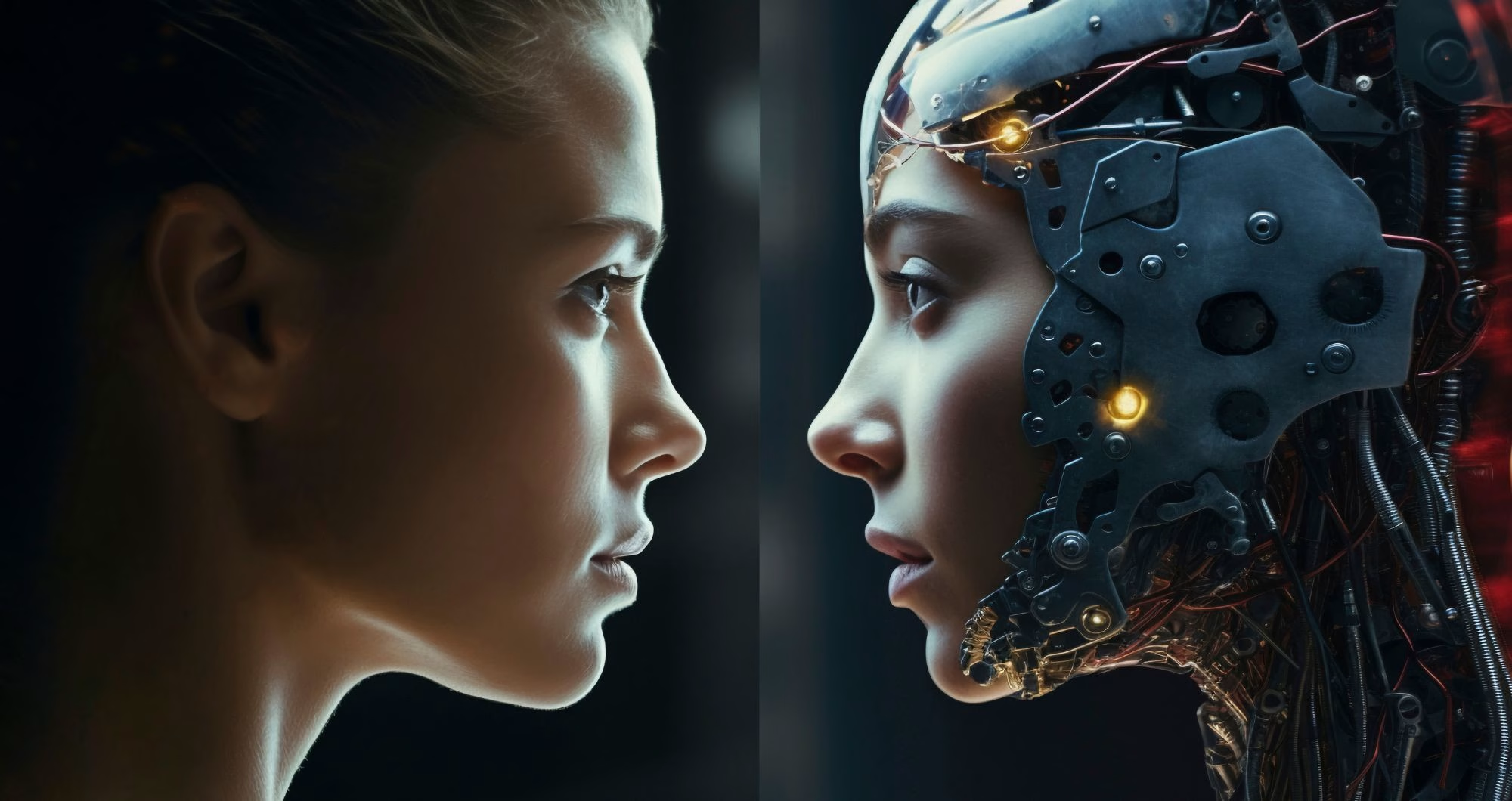
AI face-swapping is the use of machine learning—especially deep learning algorithms—to digitally transpose one face onto another in video or photo content. This is not a cut-and-paste operation. Instead, the AI analyzes facial structures, emotions, and movements to generate a realistic overlay that moves and reacts like a real face.
Key components of face-swapping include:
- Facial detection: Locating and analysing facial landmarks.
- Feature mapping: Understanding the structure and shape of facial features.
- Face synthesis: Using deep learning to generate a new face over an existing one.
- Rendering: Blending the swapped face into the source image or video in real-time.
What sets AI face-swapping apart from older methods is how well it maintains expression, emotion, and naturalism, making the output often indistinguishable from reality.
Wordle unlimited: The digital puzzle that keeps giving
On a lighter note, let’s shift from faces to words. If you’re a fan of language and logic, you’ve likely encountered Wordle—the viral word game where players guess a five-letter word in six tries. For those who found the original version too limiting with just one puzzle per day, Wordle Unlimited offers an open-ended solution.
Wordle Unlimited lets players enjoy an endless stream of word puzzles. The rules remain the same—guess the word using logic and deduction, with colored boxes guiding you toward the answer. Its endless nature, combined with its brain-training simplicity, makes it a favourite for daily wordplay lovers, educators, and even team-building exercises. Much like AO Face Swap, it’s a brilliant example of how simple tools—when well-designed—can capture global attention.
Enter AO face swap: An AI tool for realistic face transformation
Among the many face-swapping apps and platforms, AO Face Swap has gained a reputation for combining high-quality results with ease of use. Whether you’re an amateur content creator or a professional editor, AO Face Swap gives you tools to generate believable, smooth face replacements in just a few steps.
Features that make AO face swap stand out
- High-definition output
AO Face Swap excels in generating ultra-realistic images and videos that retain skin texture, lighting, and expressions. - Real-time processing
Unlike some apps that require long render times, AO Face Swap can perform face-swapping live, making it ideal for livestreaming, gaming, and virtual meetings. - User-friendly interface
No editing background is needed. You simply upload the source and target images or videos, and the AI handles everything automatically. - Cross-device accessibility
AO Face Swap is available via browser and mobile apps, providing cross-platform flexibility. - Privacy-conscious design
The developers emphasise ethical AI use. According to their privacy policy, user data is not stored beyond what is necessary for processing.
Behind the curtain: How does AO face swap work?
The magic behind AO Face Swap lies in its use of Generative Adversarial Networks (GANs)—a form of machine learning that pits two neural networks against each other. One creates fake content (the “generator”), while the other judges whether the content is real or fake (the “discriminator”). Through this adversarial training, the AI learns to create ever more realistic images.
Step-by-step process:
- Input & analysis
Users upload both the target (video/image) and source (face to be added) files. The AI identifies facial landmarks like eyes, nose, mouth, and chin. - Training & alignment
The system compares and aligns the source and target faces to ensure a match in orientation, lighting, and expressions. - Generation
The GAN-based model synthesises a new facial layer that resembles the source face but matches the expressions and context of the target face. - Blending
Finally, the AI blends the synthetic face into the target scene. Adjustments to lighting, resolution, and colour grading ensure the face looks native to the video or image. - Output
The result is a high-quality, realistic swap ready to download or share.
Where is AI face swapping being used?
Face-swapping is no longer just a gimmick—it has serious utility across many fields. Here are some of the most notable use cases:
-
Social media and content creation
Platforms like TikTok, Instagram, and YouTube are filled with entertaining face-swap clips. Whether it’s putting yourself in a movie scene or swapping faces with a celebrity, the content possibilities are endless.
-
Virtual influencers and avatars
Creators are using tools like AO Face Swap to build virtual personas or influencers, enabling brand collaborations without needing to appear on camera themselves.
-
Film and TV
Production studios use face-swapping to de-age actors, recreate historic characters, or replace stunt doubles digitally, saving time and cost in post-production.
-
Education and training
Face-swapping can bring history to life in classrooms by inserting students into historic scenes or simulations. It’s also used in role-play training modules in corporate and military environments.
-
Gaming and virtual worlds
Players and developers use AI-generated avatars and face-swapped characters in role-playing games, VR spaces, and AR apps.
Ethical risks and legal debates
With such a powerful tool comes great responsibility. While most uses of AO Face Swap are harmless or creative, there are concerning trends that have prompted debate around the world.
-
Deepfake dangers
AI face-swapping is a cornerstone of deepfake creation—synthetic media that impersonates someone in an often misleading or malicious way. Deepfakes can spread disinformation, commit fraud, or invade personal privacy.
-
Non-consensual media
One of the most disturbing abuses is the creation of explicit content without a person’s consent. Celebrities and ordinary people alike have been targeted, leading to emotional and legal fallout.
-
Erosion of trust
When seeing is no longer believing, public trust in visual media erodes. In courtrooms, journalism, or political discourse, distinguishing real from fake becomes a growing challenge.
Global legal responses
Countries and regulatory bodies are beginning to take action. Here’s a snapshot of how laws are evolving to address face-swapping and deepfakes:
- United States: Several states have introduced laws criminalising malicious use of deepfakes, particularly around elections and non-consensual adult content.
- European Union: The upcoming AI Act may classify deceptive AI tools as high-risk, subject to strict compliance rules.
- China: A leader in tech regulation, China now requires all AI-generated videos to be clearly labeled and imposes penalties for fake media distribution.
AO Face Swap, while not legally liable for user misuse, actively encourages ethical practices and transparency among its users.
The future of face-swapping technology
As AI continues to evolve, face-swapping will likely become:
- More accessible: Lower hardware and software requirements mean anyone can generate high-quality results.
- More accurate: Future tools will incorporate better lighting correction, emotion tracking, and contextual awareness.
- More regulated: Expect global standards and watermarking technologies to combat misuse.
For tools like AO Face Swap, the goal will be to lead innovation while maintaining ethical guardrails. There’s a growing push for “responsible AI”—where functionality is balanced with fairness, transparency, and user safety.
Conclusion: The dual edge of innovation
AI face-swapping is one of the most fascinating innovations of our time—capable of empowering creativity, reimagining media, and redefining how we interact with visual content. With AO Face Swap, users now have the ability to produce studio-quality results from their devices in mere moments.
But with such power comes responsibility. From identity theft to misinformation, the risks are real. Developers, regulators, and users must work together to ensure AI face-swapping becomes a force for good.