

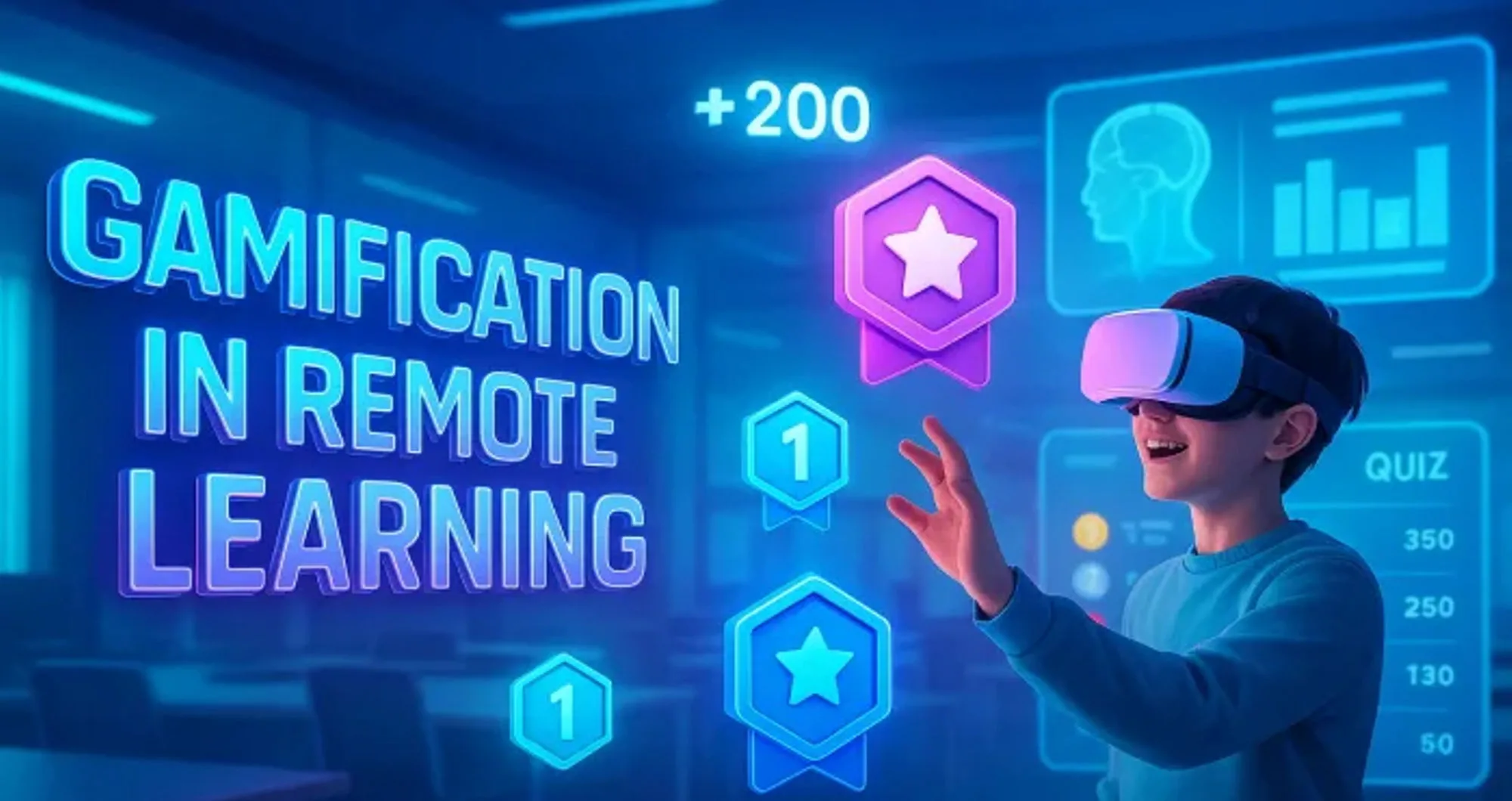

Gamification of Remote Learning revolutionises education by embedding game mechanics such as points, badges, and leaderboards into online learning spaces. This experience boosts student engagement by 50%, supports individualised learning, fosters collaboration, and enhances information recall. Technologies such as AI, IoT, VR, and AR drive these experiences, delivering interactive, immersive learning spaces that make learning both fun and impactful. Well-used platforms like Gimkit and automated resources like Blooket Bot illustrate how contemporary gamification approaches are transforming teaching and learning.
Understanding gamification in education
Gamification in Remote Learning involves applying game design principles and mechanics to non-game contexts, particularly in digital educational settings. It’s not playing games but incorporating aspects such as points, badges, leaderboards, challenges, and narratives into the learning experience. This is based on the idea of leveraging students’ inherent competitive drive and sense of accomplishment to make learning more engaging and fun.
Gamification bridges the digital divide in distant learning settings with authentic learning experiences. It converts passive, static online lessons into active, dynamic experiences that engage and sustain student interest, a feat often beyond the capabilities of ordinary methods.
Benefits of gamification in remote learning
Opens the way for customised learning
Gamification in Remote Learning aids in customising the learning process according to the specific requirements of the learner. It may be applied for the education of students in universities/schools or for training staff within an organisation. Gamified learning increases student engagement by 50 percent. This is due to the fact that learners are more likely to remain dedicated as long as they feel that their studies are focusing on their needs. In addition, individualised training within an organisational setting improves the level of productivity among employees.
Encourages collaborative learning
Research shows that gamification has proven to be a significant tool in increasing student interaction and teamwork. This is due to gamification as it instils an atmosphere in which students are busy with activities and enthusiastically engage in group tasks and projects. Incorporating features such as leaderboards, points, etc. Students are more bonded together as they rejoice in individual and team achievements.
Facilitates retention of information
Educational game elements make learning more engaging for students, increasing their attention and interest. Increased engagement brings about improved absorption and retention of knowledge.
Gamified learning offers instant feedback to students regarding areas that need enhancement. Instant reinforcement facilitates memory retention. Furthermore, it encourages active learning that adds to the rapid absorption of knowledge.
Collaborative learning is a crucial aspect of gamified learning. It sets a platform where students learn through sharing information and discussing issues, thus improving memory retention.
Offers a perspective of real-world uses
Gamification of learning enables the student to attain the results of their decisions in a safe environment. Games are typically structured in a way that the student will not move to the next level until he or she has made the correct decision or executed the correct action. This makes the students investigate the topic further and learn the implications of their learning beyond their virtual world.
Improves the learning experience
Learning becomes engaging and no longer dull and monotonous with gamified learning. Gamification in Remote Learning improves and enhances the learning experience. Students are able to learn any learning content better if they enjoy learning and are actively engaged in the process.
Top technologies that power gamified learning
Artificial Intelligence (AI)
Gamified learning is based on AI technologies like machine learning (ML), generative AI (Gen AI), etc. AI algorithms examine user behaviour and learning patterns via various stages of their branched exercises, and gaming experiences can be tailored based on these learnings. Leading universities in the U.S. and the U.K. are pioneering the use of AI-driven gamification platforms that adapt to individual student needs in real-time. AI utilities assist in generating personalised quizzes, tests, etc. for the users based on their skills and weaknesses. AI also enables creating immersive role-play situations and training simulations. ML algorithms provide predictions that assist in making improved gaming experiences in the future.
Internet of Things (IoT)
Information is collected from IoT devices such as smartphones, smartwatches, etc. and it is used to create a personalised learning and assessment experience. IoT also enables giving feedback to students on their performance in gamified activities. IoT integration enables students to remain engaged and continuously improve their skills.
Virtual Reality (VR) and Augmented Reality (AR)
AR and VR assist in designing experiential learning that renders the educational material more exciting and memorable. AR and VR are able to mimic real-life situations where students are able to practice their skills in a secure environment. In addition, AR and VR offer instant feedback to students.
AR has the ability to superimpose information on real-world objects, whereas VR has the capability to build fully interactive 3D models that make it easy for students to comprehend intricate concepts. VR encourages collaborative learning since it builds an atmosphere where students can learn collaboratively.
Furthermore, technologies like blockchain, Robotic Process Automation (RPA), etc., have also made a strong entry into the gamified learning ecosystem.
Final words
Gamification in Remote Learning is an effective method of improving the learning experience and results in digital educational settings. Embedding game mechanics in a learning environment increases engagement, motivation, and cooperation. The new methods not only improve scholastic performance but also ensure the learning process becomes fun and efficient. Finally, gamification can lead to a more interactive, inclusive and efficient learning environment that equips students to thrive in today’s complex world.