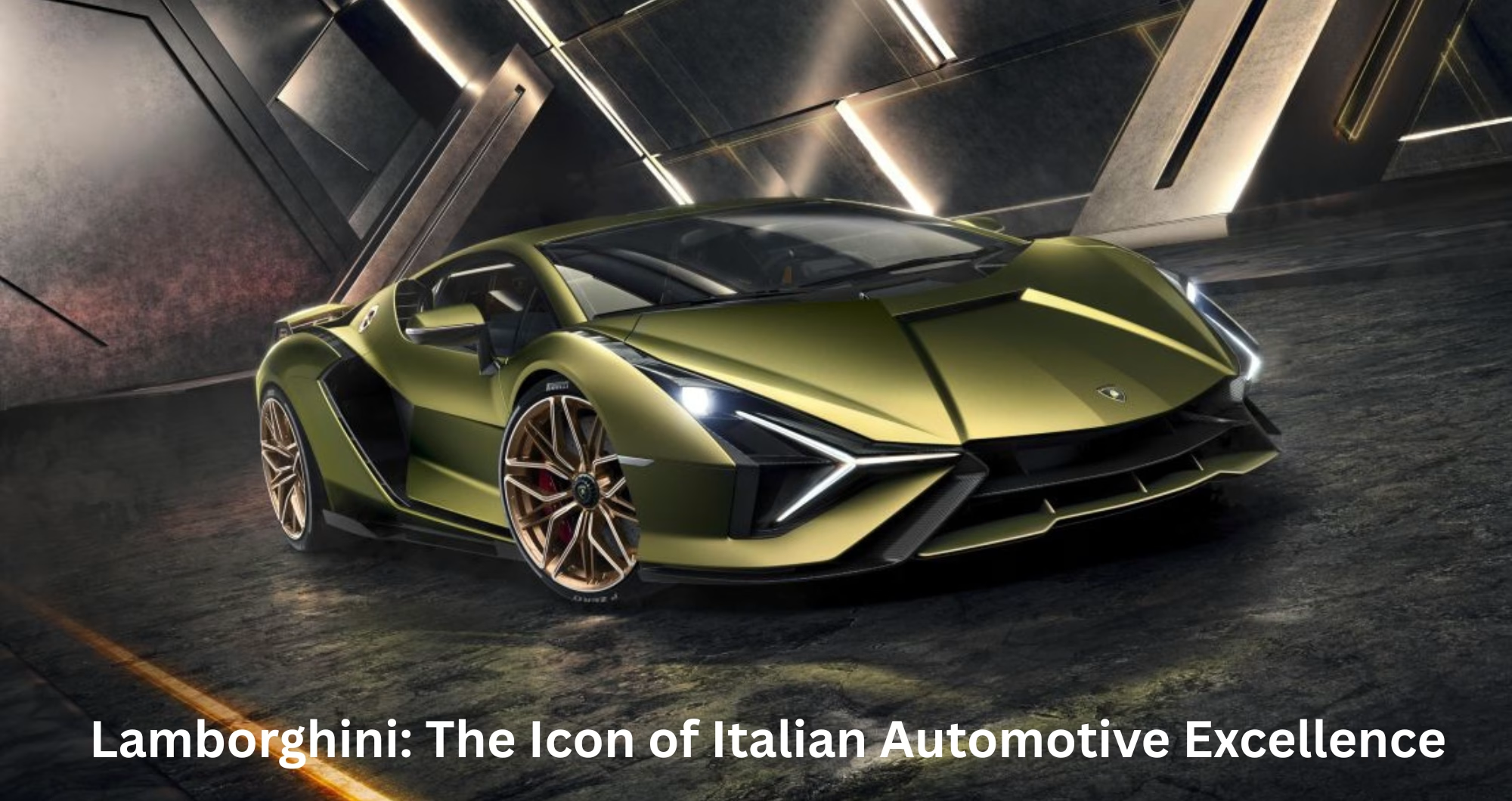

When it comes to the world of luxury supercars, few names evoke as much passion, power, and prestige as Lamborghini. The Italian marque has become synonymous with bold design, uncompromising performance, and an aura of exclusivity that attracts enthusiasts and collectors alike. Since its inception in the early 1960s, Lamborghini has consistently redefined what it means to build a high-performance automobile, pushing the limits of engineering while maintaining an artistic and flamboyant aesthetic.
This article explores the fascinating history, engineering, design philosophy, legendary models, cultural impact, and future of Lamborghini in detail.
The Origins of Lamborghini
Ferruccio Lamborghini’s Vision
Lamborghini’s story begins with Ferruccio Lamborghini, born in 1916 in Cento, Italy. A successful entrepreneur, he made his fortune after World War II by founding Lamborghini Trattori, a company specialising in the manufacture of tractors. Despite his immense success in the agricultural industry, Ferruccio was also a car enthusiast with a taste for luxury sports cars, particularly Ferraris.
However, Ferruccio found flaws in the cars he owned, particularly in their comfort and mechanical reliability. He believed he could build a better grand touring machine — one that combined speed and performance with comfort and refinement. Driven by this ambition, Ferruccio established Automobili Lamborghini in 1963, in Sant’Agata Bolognese, near Bologna, Italy.
The First Models
The company’s first car, the Lamborghini 350 GT, debuted in 1964. It was powered by a 3.5-liter V12 engine designed by Giotto Bizzarrini, a former Ferrari engineer. The car was well-received, demonstrating Lamborghini’s serious intent to compete with Ferrari, Maserati, and Aston Martin.
The follow-up model, the 400 GT, further cemented Lamborghini’s reputation for producing refined, powerful grand tourers. But the real game-changer was yet to come.
The Birth of the Supercar: Miura
In 1966, Lamborghini unveiled the Miura, a revolutionary mid-engined sports car that is often credited with creating the template for modern supercars. Designed by Marcello Gandini at Bertone, the Miura was unlike anything the world had seen before. Its sleek, low-slung body and powerful V12 engine mounted behind the driver redefined automotive design.
The Miura became an instant icon, capturing the imagination of car enthusiasts, celebrities, and the media alike. It wasn’t just a car — it was a statement of extravagance, style, and performance. The Miura’s top speed of 170 mph made it one of the fastest cars of its era. More importantly, its mid-engine layout set the standard for future high-performance cars.
Lamborghini Through the Decades
The 1970s: Innovation and Struggles
After the Miura, Lamborghini introduced another legendary model, the Countach, in 1974. Once again designed by Gandini, the Countach shocked the automotive world with its wedge-shaped design, scissor doors, and futuristic appeal. Its styling became the defining look of supercars in the 1970s and 1980s.
Despite its iconic designs, Lamborghini faced financial challenges during this decade. The 1973 oil crisis and global economic difficulties reduced demand for high-performance luxury cars. Ferruccio Lamborghini eventually sold his shares in the company, and Lamborghini passed through different ownerships.
The 1980s: Survival and Revival
Under new owners, Lamborghini continued to refine the Countach and maintain its brand identity. The Countach evolved through multiple iterations, each more powerful and extreme than the last.
During this decade, Lamborghini began to solidify its reputation not just as a car manufacturer but as a cultural symbol. The Countach adorned posters in countless bedrooms around the world, becoming a dream car for an entire generation.
The 1990s: The Diablo Era
In 1990, Lamborghini introduced the Diablo, the successor to the Countach. True to its name, the Diablo was a beastly machine with a V12 engine producing over 500 horsepower. It could reach speeds in excess of 200 mph, placing it among the fastest cars of its time.
The Diablo combined Lamborghini’s trademark flamboyant styling with cutting-edge performance. It was also the first Lamborghini to feature all-wheel drive in certain versions, a system that enhanced handling and stability.
However, Lamborghini continued to face ownership changes. The company was eventually acquired by Chrysler in 1987, then later sold to an Indonesian investment group in 1994.
The 2000s: Audi and Stability
A major turning point came in 1998 when Lamborghini was acquired by the Volkswagen Group, under its Audi division. This change provided the stability, resources, and engineering expertise Lamborghini needed to thrive.
The first major release under Audi’s ownership was the Murciélago in 2001, followed by the Gallardo in 2003. The Murciélago, a flagship V12 model, carried Lamborghini’s tradition of outrageous design and performance, while the Gallardo became the brand’s best-selling model at the time, offering a more accessible entry into the Lamborghini world.
The 2010s: Aventador and Huracán
In 2011, Lamborghini introduced the Aventador, a V12 flagship that once again pushed the boundaries of design and technology. Its aggressive styling, carbon-fiber monocoque, and advanced aerodynamics made it one of the most desirable supercars of its era.
Two years later, the Huracán replaced the Gallardo as Lamborghini’s entry-level model. With its naturally aspirated V10 engine, refined handling, and advanced driver aids, the Huracán quickly became a bestseller and a favorite among enthusiasts.
During this era, Lamborghini also began experimenting with limited-run hypercars, such as the Veneno, Centenario, and Sián, showcasing futuristic designs and hybrid technologies.
The 2020s: Expanding Horizons
Lamborghini has continued to innovate in the 2020s. The Aventador and Huracán remain core products, but the company has also ventured into the SUV market with the Urus, introduced in 2018. The Urus quickly became a commercial success, broadening Lamborghini’s customer base while maintaining performance credentials.
Additionally, Lamborghini has committed to electrification, with plans to introduce hybrid powertrains across its lineup while preserving the emotion and drama that define its cars.
Lamborghini Design Philosophy
Lamborghini’s design philosophy is rooted in boldness, drama, and futuristic aesthetics. Unlike its competitors, Lamborghini embraces sharp angles, aggressive lines, and attention-grabbing features that make its cars instantly recognisable.
Exterior Design
From the Miura’s curves to the Countach’s wedges and the Aventador’s fighter jet-inspired form, Lamborghini’s design language emphasises innovation. Scissor doors, angular headlights, and aerodynamic sculpting have become brand signatures.
Interior Design
Inside, Lamborghini balances luxury with performance-oriented functionality. Cockpits are often inspired by aircraft, with digital displays, fighter-jet-style switches, and premium materials such as Alcantara, carbon fiber, and leather.
Engineering Excellence
Beyond aesthetics, Lamborghini’s engineering prowess ensures that performance matches appearance. Lightweight construction, advanced aerodynamics, and high-revving naturally aspirated engines have been hallmarks of the brand. The company also incorporates cutting-edge technologies like active aerodynamics and hybrid powertrains in its latest models.
Legendary Lamborghini Models
-
Lamborghini Miura (1966–1973) – The original supercar, setting the standard for mid-engine design.
-
Lamborghini Countach (1974–1990) – A cultural phenomenon with its wedge shape and scissor doors.
-
Lamborghini Diablo (1990–2001) – The first Lamborghini to break the 200 mph barrier.
-
Lamborghini Murciélago (2001–2010) – A modern classic and the last Lamborghini with a naturally aspirated V12 developed before Audi’s influence fully took hold.
-
Lamborghini Gallardo (2003–2013) – The brand’s best-seller that brought Lamborghini to a wider audience.
-
Lamborghini Aventador (2011–present) – The V12 flagship of the modern era, combining extreme performance with dramatic styling.
-
Lamborghini Huracán (2014–present) – The accessible supercar with a V10 engine and advanced driving aids.
-
Lamborghini Urus (2018–present) – A high-performance SUV that redefined Lamborghini’s market presence.
-
Special Editions – Limited-run models like the Reventón, Veneno, Centenario, and Sián highlight Lamborghini’s ability to push boundaries.
Lamborghini in Popular Culture
Lamborghini has become more than just a car brand; it is a cultural icon. Its cars appear in movies, video games, music videos, and celebrity garages around the world.
- Movies: From the Miura in the opening of The Italian Job (1969) to the Aventador in The Dark Knight Rises (2012), Lamborghinis have starred in cinematic moments.
- Video Games: Franchises like Need for Speed, Gran Turismo, and Forza Horizon feature Lamborghinis as dream cars for players.
- Music and Lifestyle: Lamborghini is often referenced in songs and rap lyrics as a symbol of wealth and success.
The brand’s flamboyance and exclusivity make it a symbol not just of automotive passion but of aspirational luxury.
Lamborghini’s Racing Legacy
While Lamborghini has historically focused on road cars, it has also made its mark in motorsport. Unlike Ferrari, which built its reputation on Formula 1, Lamborghini concentrated on sports car racing and one-make series.
The Lamborghini Super Trofeo series allows owners to race specially prepared Huracáns in a competitive environment. Lamborghini also competes in endurance racing through GT3 versions of its cars, achieving victories at prestigious events like the 24 Hours of Daytona.
The Future of Lamborghini
As the automotive industry moves toward electrification, Lamborghini faces the challenge of maintaining its identity in a changing landscape. The company has announced plans for hybridized versions of its main models, with the first hybrid V12 successor to the Aventador already revealed.
Despite these changes, Lamborghini promises to preserve the emotional experience — the sound, design, and thrill — that has defined its cars for decades. The future may include fully electric Lamborghinis, but the company is committed to ensuring they remain dramatic, exclusive, and unmistakably Lamborghini.
Conclusion
Lamborghini is far more than a car manufacturer; it is a symbol of passion, daring, and innovation. From Ferruccio Lamborghini’s vision in the 1960s to today’s cutting-edge supercars and SUVs, the brand has consistently pushed the boundaries of design and performance.
Every Lamborghini tells a story of audacity, from the Miura’s pioneering layout to the Countach’s poster-worthy design, the Diablo’s raw power, and the Aventador’s futuristic presence. Beyond the cars themselves, Lamborghini has left an indelible mark on popular culture, motorsport, and the dreams of enthusiasts worldwide.