
Film noir didn’t just give us shadowy detectives and femme fatales – it fundamentally rewired how directors think about visual storytelling. From the rain-slicked streets of 1940s Los Angeles to the neon-soaked cityscapes of Blade Runner 2049, noir’s influence extends far beyond its golden age, creating a visual grammar that modern filmmakers still speak fluently.
The genre emerged from a perfect storm of artistic innovation and practical necessity. German expressionist cinematographers, fleeing to Hollywood in the 1930s, brought their dramatic lighting techniques to American studios operating on wartime budgets. This collision of European artistry and American pragmatism created something unprecedented: a visual style so distinctive that French critics coined a new term for it when they finally saw these films after World War II. At Best Movies, we’ve analysed hundreds of noir films to understand exactly how these techniques continue to shape contemporary cinema.
Understanding noir’s visual DNA requires examining its most revolutionary innovation: the deliberate use of darkness as a narrative element. Before noir, Hollywood lighting aimed for clarity and glamour. Directors like John Huston and cinematographer John Alton flipped this convention, using shadows to reveal character psychology. In The Big Sleep (1946), Humphrey Bogart’s Philip Marlowe often appears bisected by light and shadow, visualising his moral ambiguity. This technique appears throughout our comprehensive movie reviews, where we trace how directors weaponised lighting to explore post-war anxiety and urban alienation.
The geometry of noir composition revolutionised film framing. Dutch angles, extreme low angles, and frames within frames became visual metaphors for psychological states. Consider the iconic staircase shot in Double Indemnity (1944), where Barbara Stanwyck descends toward Fred MacMurray – the camera angle transforms a simple entrance into a predatory advance. Modern thrillers from Se7en to Zodiac employ identical techniques, proving noir’s compositional principles remain essential. Our analysis of influential directors demonstrates how these angular compositions create unease without requiring explicit violence or action. For more film analysis and reviews, visit https://bestmoviesnewmovies.com/.
The Architecture of Shadows: Core Visual Elements
Noir’s visual vocabulary consists of five essential elements that directors still employ to create atmosphere and meaning. First, chiaroscuro lighting – the dramatic interplay of light and dark borrowed from Renaissance painting – transforms ordinary spaces into psychological landscapes. Watch how sunlight through venetian blinds creates prison-bar shadows across characters’ faces, suggesting entrapment even in freedom.
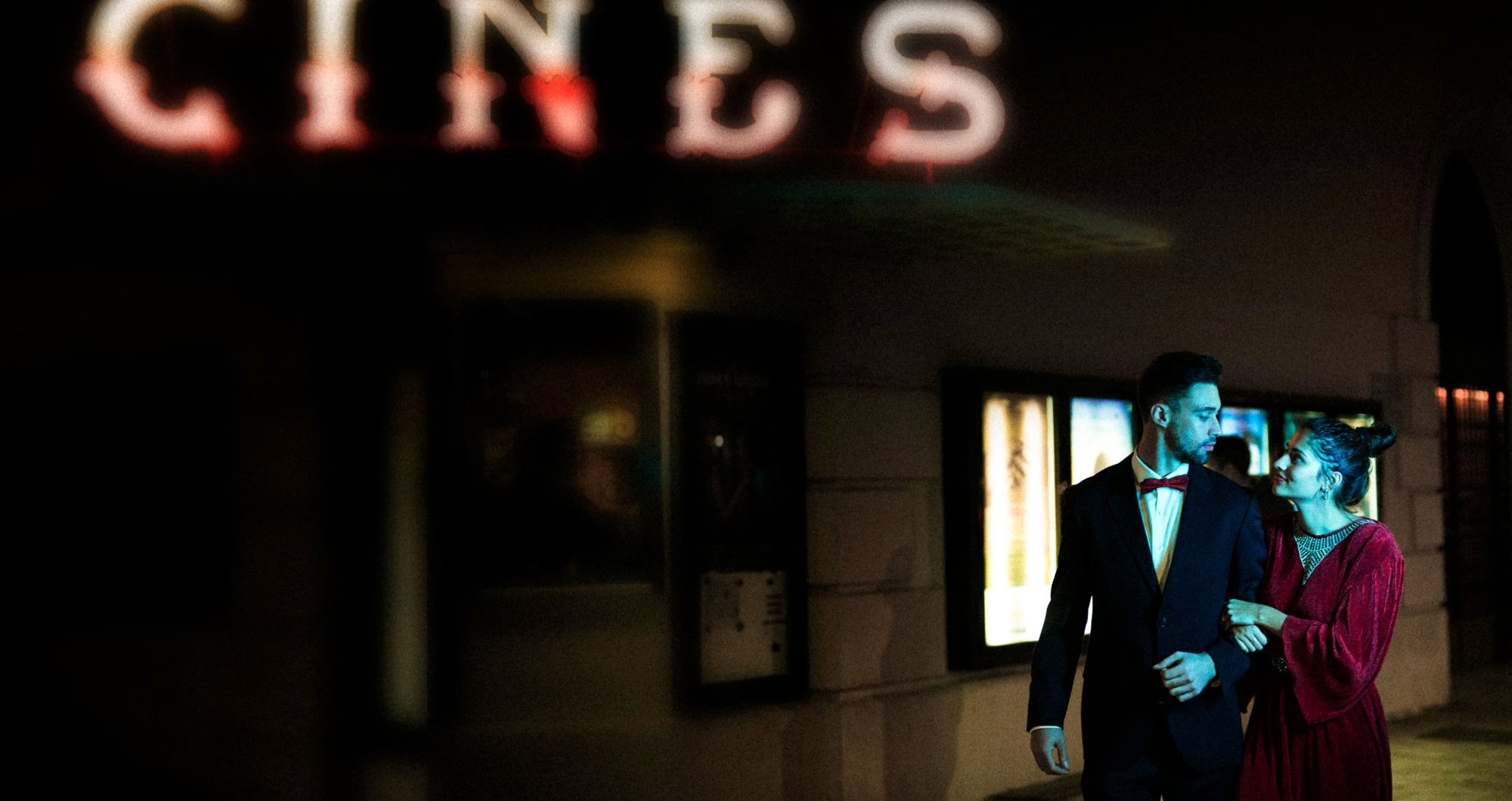
Second, the urban environment becomes a character itself. Noir treats cities as labyrinths where danger lurks in every alley and moral corruption seeps through rain-soaked streets. The city at night, with its neon signs reflected in puddles and steam rising from manholes, creates a dreamlike quality that distances viewers from reality while paradoxically making everything feel more immediate and threatening.
Third, mirror shots and reflections multiply perspectives and suggest fractured identities. Characters often appear in multiple reflections simultaneously, visualising their internal conflicts. The Lady from Shanghai (1947) pushes this to its extreme in the famous hall of mirrors climax, where identity literally shatters into fragments.
Fourth, smoke and fog serve both practical and symbolic purposes. Cigarette smoke creates depth in black-and-white photography while suggesting moral haziness. Fog obscures vision, making the familiar strange and heightening paranoia. These atmospheric elements transform mundane locations into spaces where anything might happen.
Fifth, noir pioneered the use of actual locations rather than studio sets. Shooting on real streets at night gave films a documentary quality that contrasted powerfully with their melodramatic narratives. This tension between realism and stylisation defines noir’s aesthetic appeal.
Psychological Landscapes: How Noir Visualises Internal States
The genius of noir lies in externalising internal psychology through visual means. A character’s mental state manifests in their environment – cluttered rooms suggest confused minds, while stark, empty spaces reflect isolation. Windows become metaphors for transparency or barriers, depending on whether characters look through them or see their own reflections.
Staircases hold particular significance in noir iconography. Ascending stairs suggests ambition or escape; descending implies moral decline or entrapment. The vertical movement through space becomes a moral journey, with landings serving as decision points where characters pause before committing to their paths.
Water appears constantly in noir, from rain-slicked streets to waterfront locations. Water reflects, distorts, and cleanses, serving multiple symbolic functions. Rain creates a veil between the camera and action, suggesting that we’re never seeing the complete truth. Waterfront scenes often represent boundaries between legitimate society and the criminal underworld.
The noir city exists in perpetual night or twilight. When daylight appears, it’s often harsh and revealing, stripping away the shadows that characters use for concealment. This temporal displacement – where most action occurs at night – creates a world operating on different rules from normal society.
Technical Innovations: The Mechanics of Mood
Noir filmmakers developed numerous technical innovations that became standard practice. Deep focus photography, perfected by Gregg Toland in Citizen Kane (1941), allowed directors to stage action on multiple planes simultaneously. Characters could lurk in the background while maintaining sharp focus, creating visual tension through spatial relationships.
Low-key lighting ratios – where the fill light is significantly dimmer than the key light – create the dramatic shadows noir is famous for. This technique requires precise planning, as actors must hit exact marks to maintain proper lighting. The difficulty of achieving these effects made every shot deliberate and meaningful.
Wide-angle lenses distort space, making rooms appear larger and more oppressive while exaggerating facial features in close-ups. This distortion creates a subtle sense of unease, suggesting that the world itself is somehow wrong. Combined with low camera angles, wide lenses make characters appear to loom over viewers, increasing their apparent power or threat.
Night-for-night shooting – actually filming at night rather than using filters to simulate darkness – gave noir its authentic atmosphere. This technique required faster film stock and portable lighting equipment, pushing technical boundaries. The grainy quality of high-speed film became part of noir’s aesthetic, adding texture that enhanced the genre’s raw feeling.
“When we examine noir’s technical achievements, we’re really looking at problem-solving under constraints. Limited budgets forced directors to find creative solutions that became artistic breakthroughs. The shadow that hides a cheap set becomes more expressive than any elaborate construction could be.” – Ciaran Connolly, Best Movies
The Femme Fatale: Visual Coding of Dangerous Women
The femme fatale represents noir’s most iconic character type, and her visual presentation established conventions still used today. Initial appearances often emphasise glamour and sophistication – perfectly waved hair, elegant clothing, immaculate makeup. This polished surface suggests control and calculation, contrasting with the dishevelled appearances of male protagonists.
Lighting plays crucial roles in revealing the femme fatale’s dual nature. Soft, glamour lighting for seduction scenes shifts to harsh, dramatic shadows during moments of revelation. The famous venetian blind shadows falling across faces became visual shorthand for moral ambiguity, suggesting prison bars that trap both the woman and her victims.
Costume design reinforces character psychology. Dark colours, form-fitting silhouettes, and luxurious fabrics suggest sensuality and danger. Accessories like cigarette holders, gloves, and jewelry become props that characters manipulate, demonstrating their performative nature. The femme fatale’s appearance is always deliberate, never casual.
Camera angles emphasise power dynamics. Low angles during the femme fatale’s introduction make her appear dominant, while high angles during vulnerable moments reveal hidden fragility. The shifting perspectives keep audiences off-balance, never certain whether to sympathise with or fear these characters.
International Noir: Global Interpretations of Shadow
While noir originated in Hollywood, international filmmakers adapted its visual language to explore their own cultural anxieties. French polar films emphasised existential themes, using noir aesthetics to examine post-war ennui. Jean-Pierre Melville’s Le Samouraï (1967) strips noir to its essential elements – a lone figure navigating an indifferent city where loyalty and betrayal become meaningless distinctions.
Japanese noir, particularly in the yakuza films of Seijun Suzuki and Kinji Fukasaku, exploded noir’s visual restraint into baroque excess. Colours replace shadows as mood indicators, with reds suggesting violence and blues indicating melancholy. These films demonstrate that noir’s principles transcend the black-and-white photography that originally defined them.
British noir maintained the genre’s fatalism while adding class consciousness. Films like Night and the City (1950) use London’s bomb-damaged landscapes as naturally noir settings, where rubble and reconstruction create ready-made shadow plays. The British approach emphasises systemic corruption over individual moral failings.
Nordic noir, popularised through television series like The Killing, adapts noir’s visual bleakness to Scandinavian landscapes. Perpetual winter darkness replaces Los Angeles nights, while minimalist architecture creates geometric compositions reminiscent of classic noir framing. The cold, clinical aesthetic suggests that corruption exists even in supposedly perfect societies.
Neo-Noir: Digital Shadows and Neon Dreams
The transition to colour film challenged filmmakers to translate noir’s monochromatic aesthetic. Chinatown (1974) solved this by using earth tones and dust-filtered light to create a sepia-tinted world that felt simultaneously contemporary and nostalgic. The film proves that noir’s essence lies in mood and moral ambiguity rather than specific visual techniques.
Blade Runner (1982) created the definitive neo-noir aesthetic by replacing shadows with neon and rain. The film maintains noir’s vertical compositions – characters constantly move up and down through the city’s levels – while adding layers of visual information impossible in black-and-white. Advertising screens replace venetian blinds as light sources, creating moving shadows that suggest a world in constant flux.
Digital cinematography opened new possibilities for noir aesthetics. Films like Collateral (2004) use digital cameras’ sensitivity to capture Los Angeles at night with unprecedented clarity. The city appears both hyperreal and dreamlike, maintaining noir’s tension between documentary and expressionism. Digital colour grading allows precise control over mood, with filmmakers able to drain or saturate colours to psychological effect.
Contemporary noir often acknowledges its own artificiality. Drive (2011) presents Los Angeles as a neon-soaked dreamscape where the protagonist literally wears a costume (his scorpion jacket) that signals his role in the narrative. This self-awareness doesn’t diminish the style’s power – instead, it creates additional layers of meaning for audiences familiar with noir conventions.
Television Noir: Long-Form Shadows
Television’s extended narratives allow for deeper exploration of noir themes and aesthetics. True Detective (2014) uses Louisiana’s industrial landscape to create naturally noir settings where refineries and chemical plants generate the shadows and smoke that classic noir achieved through studio lighting. The series’ time-jumping structure mirrors noir’s flashback-heavy narratives while adding complexity impossible in feature-length films.
Streaming platforms enable even darker visual approaches, as home viewing allows for subtler shadow detail than theatrical projection. Ozark uses blue-grey colour grading to create perpetual twilight, suggesting moral ambiguity through colour temperature rather than contrast. The series demonstrates how noir aesthetics adapt to different regions – the Missouri lakes becoming noir’s waterfront, rural darkness replacing urban shadows.
Limited series like Mare of Easttown prove that noir principles apply to any setting. Philadelphia suburbs become noir landscapes through careful attention to lighting and composition. Overhead shots of suburban streets create the same sense of entrapment that aerial views of Los Angeles provided in classic noir. The visual language remains consistent even as settings change.
Practical Applications: Using Noir Techniques Today
Modern filmmakers continue finding new applications for noir techniques. Horror films use noir lighting to create dread – It Follows (2014) employs classic noir compositions to suggest suburban threats. Science fiction adapts noir’s urban paranoia to futuristic settings – Minority Report (2002) uses bleached, overexposed cinematography to create a noir negative, where too much light becomes as oppressive as shadow.
Documentary filmmakers employ noir aesthetics to suggest corruption and conspiracy. The Act of Killing (2013) has its subjects recreate their crimes in noir style, using the genre’s visual language to explore how killers mythologise their actions. The film demonstrates noir’s continued relevance for examining moral ambiguity.
Music videos and commercials raid noir’s visual toolkit for instant atmosphere. A silhouette against venetian blind shadows immediately establishes mood without requiring narrative context. These abbreviated forms prove noir’s visual efficiency – a single shot can convey complex emotional states that would require pages of dialogue to explain.
Video games like L.A. Noire and Max Payne translate noir aesthetics into interactive media. Players navigate noir spaces, making moral choices that affect lighting and colour saturation. The interactive nature adds new dimensions to noir’s exploration of moral ambiguity – players become complicit in the corruption noir traditionally observes from a distance.
The Grammar of Modern Thrillers
Contemporary thrillers speak fluent noir even when they avoid its obvious visual markers. Sicario (2015) uses desert sunlight to create noir effects – overwhelming brightness becomes as disorienting as shadow. The film’s aerial shots of the border create geometric patterns reminiscent of noir’s urban grids, suggesting that corruption follows similar patterns regardless of setting.
Nightcrawler (2014) updates noir’s critique of urban alienation for the digital age. Los Angeles at night appears as noir always depicted it – a sprawling network of lights suggesting infinite possibility and danger. The protagonist’s amoral pursuit of success through crime echoes classic noir narratives while his video camera adds a layer of mediation that comments on contemporary image culture.
Directors like David Fincher have built careers on refined noir aesthetics. His films feature precise compositions where every element serves narrative purposes. Gone Girl (2014) uses suburban architecture to create naturally noir frames – doorways, windows, and stairs segment spaces into zones of knowledge and deception. The film’s cold, clinical look suggests noir drained of romanticism.
The John Wick franchise demonstrates noir’s influence on action cinema. Neon-lit nightclubs, rain-slicked streets, and geometric compositions create noir atmosphere while the protagonist’s rigid moral code – completing the job regardless of consequences – echoes noir’s fatalistic worldview. The films prove noir’s visual language enhances any genre willing to embrace moral complexity.
Frequently Asked Questions
What defines film noir’s visual style? Film noir’s visual style is characterised by high-contrast lighting (chiaroscuro), dramatic shadows often created by venetian blinds, urban night settings, unusual camera angles including Dutch tilts, and compositions that emphasise geometric patterns. The style uses darkness as a narrative element, with shadows revealing character psychology and moral ambiguity rather than simply creating atmosphere.
Which modern films best demonstrate noir influence? Blade Runner 2049, Drive, Nightcrawler, and Gone Girl exemplify modern noir influence through their use of urban landscapes, morally ambiguous protagonists, and sophisticated lighting techniques. Television series like True Detective and Mare of Easttown extend noir aesthetics into long-form narratives, while films like Sicario adapt noir principles to daylight settings.
How did film noir change cinematography techniques? Noir pioneered several cinematography innovations including deep focus photography, low-key lighting ratios, night-for-night shooting, and extensive use of practical locations. These techniques pushed technical boundaries, with cinematographers developing new ways to expose film and light scenes. The genre’s emphasis on visual storytelling over dialogue influenced all subsequent filmmaking.
What makes the femme fatale such an enduring character type? The femme fatale endures because she embodies complex contradictions – simultaneously powerful and vulnerable, independent yet trapped by circumstance. Her visual coding through lighting, costume, and camera angles created a template for presenting dangerous women that films still use. The archetype speaks to anxieties about gender, power, and desire that remain culturally relevant.
Where can I watch essential film noir in the UK? Classic noir films are available across UK streaming platforms: BBC iPlayer regularly features noir seasons, while services like MUBI and BFI Player maintain extensive noir collections. The Third Man streams on multiple platforms, Double Indemnity appears on Sky Cinema, and Talking Pictures TV broadcasts classic noir weekly. The BFI Southbank in London regularly screens noir retrospectives in theatrical presentations.
The Endless Night: Noir’s Eternal Relevance
Film noir’s visual language endures because it externalises internal conflicts that remain universally relevant. The shadow across a face, the rain on dark streets, the geometric patterns of urban architecture – these images resonate because they visualise experiences of alienation, desire, and moral compromise that transcend specific historical moments.
Modern filmmakers don’t simply imitate noir’s surface aesthetics; they adapt its principles to explore contemporary anxieties. Where classic noir examined post-war disillusionment, neo-noir investigates digital-age isolation. The visual techniques remain effective because they tap into fundamental ways humans process visual information – we instinctively read shadows as danger, height as power, and water as transformation.
The democratisation of filmmaking tools means noir’s influence extends beyond professional productions. Independent filmmakers use noir techniques to create atmosphere on minimal budgets, proving that shadows remain cheaper and more effective than elaborate sets. The style’s efficiency ensures its continued relevance in an era of content abundance where grabbing attention quickly becomes essential.
As we face new technological and social challenges, noir’s visual vocabulary provides ready-made tools for exploring moral ambiguity. Whether examining algorithmic bias, climate catastrophe, or social isolation, filmmakers will continue finding noir’s shadows useful for illuminating dark truths. The genre’s gift to cinema wasn’t just aesthetic beauty but a complete visual language for discussing difficult subjects.
Film noir taught cinema that style and substance need not be separate – that how something is shown can be as meaningful as what is shown. This integration of form and content represents noir’s greatest achievement and explains why filmmakers return to its techniques decade after decade. In teaching us to read shadows, noir permanently expanded cinema’s expressive possibilities.