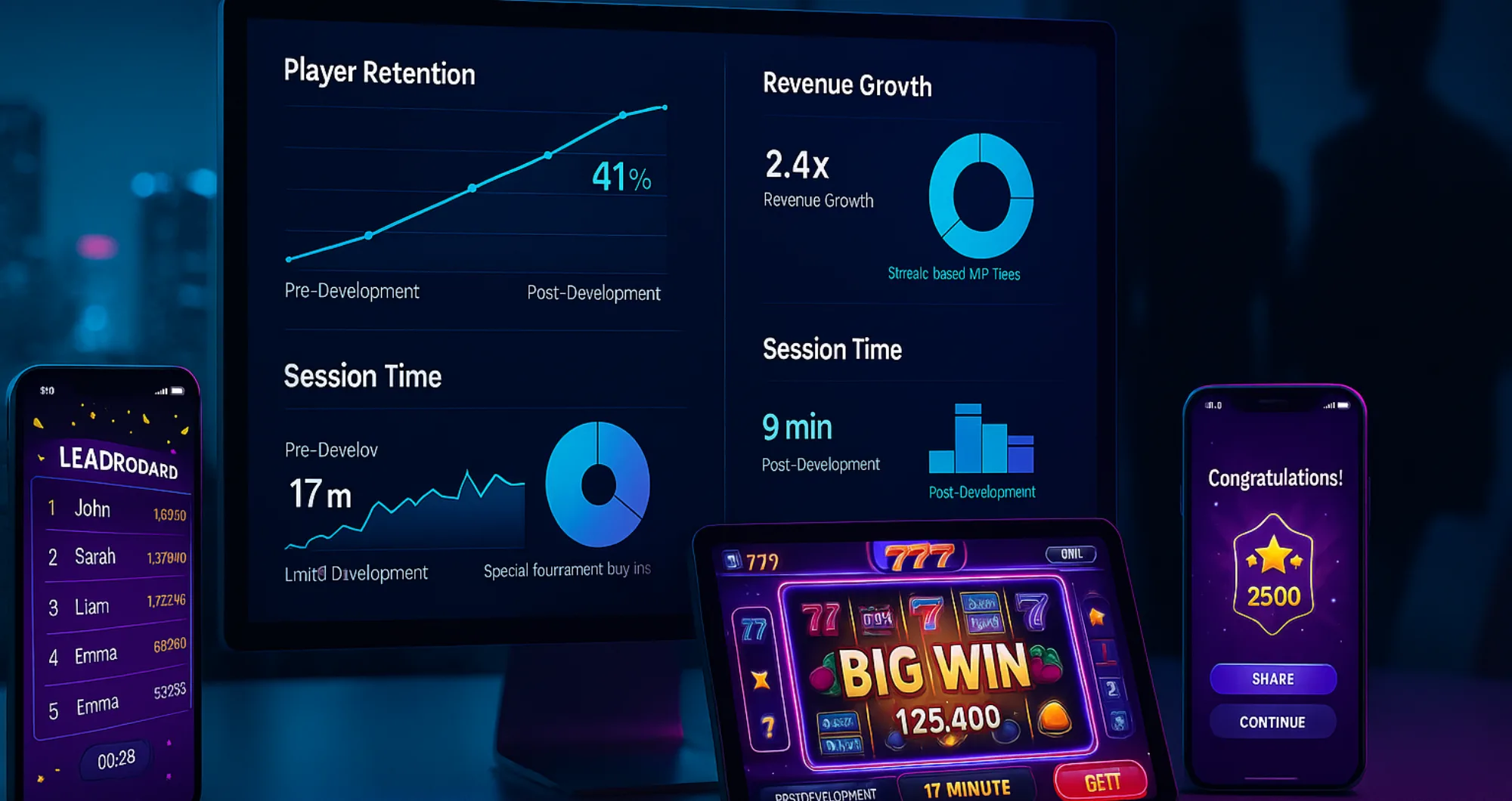

NeonPulse Casino is a social-first mobile casino platform recognised for its innovative features, including live leaderboards, streak rewards, and interactive social badges. However, despite a strong initial user base, NeonPulse faced significant challenges with player retention, engagement, and revenue growth. This in-depth case study examines how strategic collaboration with leading casino game developers and the deployment of advanced game development solutions drove sustained business transformation.
Market Context: Why Mobile Casinos Need Innovation
- The mobile casino market is extremely crowded, with user acquisition costs escalating and retention rates typically low.
- Players expect dynamic, social, and personalised experiences—not just traditional slot mechanics.
- To remain competitive, operators must invest in casino game development that integrates data-driven design, behavioural psychology, and technical scalability.
NeonPulse Casino Overview and Business Challenges
Platform Snapshot
- Games: 400+ neon-style slots, fast tables, real-time tournaments.
- Social: Hourly leaderboards, shareable badges, friend challenges.
- Rewards: Streak meter unlocking free spins and prize drops.
- Notifications: Smart push alerts optimised for player peak times.
Early Growth Versus Real Retention
- Rapid user acquisition through influencer campaigns.
- High Day 1 installs, but steep drop-offs by Day 7 and Day 30.
- Monetisation lagged industry standards, with most revenue tied to sporadic prize events.
Core Pain Points
- Players didn’t form daily habits or emotional investment in the ecosystem.
- Feature releases were slow due to technical bottlenecks.
- Engagement plateaued, especially after novelty faded.
Setting Clear Goals for Transformation
Stakeholder Priorities
- Deliver a long-term boost in retention, revenue per user, and engagement.
- Create a technically agile platform for ongoing growth.
- Use casino game development to introduce innovative, differentiated features.
Defining Success Metrics
- Retention: Day 1, Day 7, Day 30 return rates.
- Revenue: In-app purchase volume, ARPDAU.
- Engagement: Average session length, DAU/MAU ratio.
Selecting the Right Casino Game Development Partner
What Sets Elite Casino Game Developers Apart
- Demonstrated expertise in designing engaging, scalable games.
- Mastery of player psychology, segmentation, and personalised progression systems.
- Proficiency in real-time analytics, CRM integration, and rapid feature iteration.
Partner Selection Process
- Rigorous technical evaluation and references.
- Joint agile teams and shared KPIs for transparent accountability.
- Commitment to continuous optimisation and A/B testing.
Multi-Layered Challenges in the Casino Sector
Player Retention Obstacles
- Sharp drop-off after initial sessions.
- Rewards lacked sustained progression or personalisation.
Monetisation Barriers
- Low conversion on in-app purchases due to generic offers.
- No structured VIP tiers or urgency-driven sales.
- Underutilised segmentation for targeted bundles.
User Engagement and Social Interaction Gaps
- Repetitive content cycles, static leaderboards.
- Weak social competition and limited group challenges.
Technical Bottlenecks
- The legacy backend limited experimentation.
- Manual QA processes delayed new releases and bug fixes.
The Technical and Strategic Solution
Product Architecture and Technology Stack
- Frontend: React Native for rapid mobile deployment.
- Game Engines: Phaser (HTML5) and Cocos2d-JS for diverse slot game mechanics.
- Backend: Node.js on AWS Lambda, using serverless scaling for global reach.
- Data: MongoDB for event-driven, real-time player profiles.
Feature Engineering and Innovation
Multi-Tiered Streak Systems
- Daily, weekly, and event-based streak rewards are tailored to player activity.
- Advanced notification logic to prompt engagement at critical moments.
Dynamic Social Features
- Animated badge sharing with in-game perks for social posts.
- Social gifting and collaborative team challenges to boost viral growth.
Real-Time Leaderboards
- Hourly, daily, and weekly leaderboards, each with unique prize pools.
- Surge events with dynamically growing rewards based on user participation.
Personalised Progression Paths
- Player archetype analysis drives mission variety and exclusive unlocks.
- Machine learning models predict optimal reward and mission timing.
Advanced Monetisation Strategies
- VIP Laddering: Structured tiers, special events, and progressive jackpots for big spenders.
- Algorithmic Flash Sales: Time-limited offers triggered by player behaviour (churn risk, engagement dips).
- Segmentation-Driven Bundles: Custom coin packs and slot unlocks for different player segments.
Analytics, Data Infrastructure, and Automation
- Predictive churn modelling for personalised retention offers.
- Full CRM integration for cross-channel engagement (push, email, in-app).
- Real-time A/B testing, feature flags, and instant rollback capability.
Continuous Delivery and Operational Excellence
- CI/CD pipelines with automated regression testing for stable, rapid deployments.
- Crowdtesting across regions and devices for quality and localisation.
Implementation Timeline and Execution
Agile Development Cycle
- Sprint-based approach, with frequent stakeholder reviews.
- Design and engineering sprints run in parallel for speed and alignment.
Risk Management and Testing
- Early resolution of data schema conflicts and real-time feature scaling.
- Modular codebase for rapid troubleshooting and feature expansion.
Feature Rollout Phases
- Discovery & Player Research (3 weeks)
- Core Feature Development (6 weeks)
- Full Platform Rollout (8 weeks)
- Ongoing Optimisation & A/B Testing
Data-Driven Results and Measurable Gains
Retention Metrics
- Day 7 Retention: Increased from 22% to 41%.
- Streak meters and social triggers are identified as major contributors.
Revenue Growth Analytics
- In-App Purchase Revenue: 2.4x increase in six months.
- The VIP system is responsible for 39% of new revenue.
Engagement and Session Time Expansion
- Average Session Time: Rose from 9 to 17 minutes.
- Live events and group challenges doubled session frequency.
DAU/MAU Improvement
- Daily Active Users: Grew from 15,000 to 33,000 (+120%).
- Social competitions and dynamic leaderboards drove user return.
Why This Casino Game Development Strategy Worked
Player Psychology and Experience Design
- Loss Aversion: Streak meters and milestone tracking keep users returning.
- Social Status: Leaderboards, sharing, and group play drive recognition and competition.
- Reciprocity and FOMO: Social gifting and time-limited offers increase urgency and virality.
Technical Scalability and Reliability
- Serverless backend and modular frontend enable global scaling.
- Real-time analytics allow instant personalisation and offer optimisation.
Social Virality and Network Effects
- Every social share generates organic installs and increases player engagement.
- Group challenges and collaborative leaderboards build a lasting community.
Lessons Learned and Actionable Takeaways
When developing advanced casino gaming platforms, certain strategic approaches can dramatically improve performance, user engagement, and scalability. Here are essential best practices every developer and operator should adopt:
1. Integrate Analytics and User Segmentation Early
From the initial stages of development, it’s vital to embed powerful analytics tools and user segmentation capabilities. This approach ensures that player behaviour, engagement patterns, and spending habits are tracked from day one. By capturing these insights early, the platform can optimise promotions, personalise gameplay experiences, and refine retention strategies with data-backed precision.
2. Adopt Agile Development for Rapid Enhancements
Agile development is no longer optional—it’s essential for casino gaming platforms that need to evolve quickly. By using agile methodologies, teams can release features in small, iterative updates, gather user feedback, and make rapid improvements. This enables faster response to market trends, bug fixes, and shifts in user preferences, keeping the platform competitive and innovative.
3. Prioritise Modular Features for Flexibility and Scale
Designing features with modularity in mind allows for easier testing, faster deployment, and simpler scaling. Modular components make it easier to isolate issues during development, experiment with new features without affecting the core system, and expand the platform’s capabilities over time. This architecture also supports A/B testing and phased rollouts.
4. Invest in Real-Time Social Mechanics
Static content no longer satisfies today’s competitive players. Developers must focus on integrating real-time social features that allow players to interact, compete, and collaborate instantly. Features such as live chat, social tournaments, leaderboards, and real-time friend invites not only boost engagement but also build stronger, more connected player communities that drive long-term retention..
Pitfalls to Avoid
While incorporating best practices is crucial, it’s equally important to recognise common pitfalls that can significantly hinder platform growth and user satisfaction:
1. Over-Reliance on Static Rewards and Basic VIP Models
Many platforms fall into the trap of offering generic loyalty rewards or simple VIP tiers. This outdated approach fails to inspire long-term engagement. Players today expect dynamic, personalised, and skill-based rewards that adapt to their in-game achievements and preferences.
2. Skipping Automation in Quality Assurance
Manual quality assurance may seem cost-effective initially, but it severely limits scalability and slows down release cycles. Automated QA testing is critical for maintaining a stable platform, especially as updates become more frequent. Automation helps catch bugs early, ensures consistent performance across devices, and accelerates the development timeline.
3. Delaying Localisation Efforts
Expanding into global markets requires more than just translating the app interface. Delaying localisation efforts can limit your platform’s growth potential. Players across regions expect localised currencies, payment methods, languages, and culturally relevant promotions. Ignoring localisation delays market entry and alienates potential users in high-growth regions.
Final Verdict
NeonPulse Casino’s transformation showcases the immense power of deep, data-driven casino game development. By collaborating closely with a skilled casino game development company and focusing on behavioural design, robust technology, and a holistic player journey, NeonPulse achieved measurable improvements in retention, engagement, and revenue.